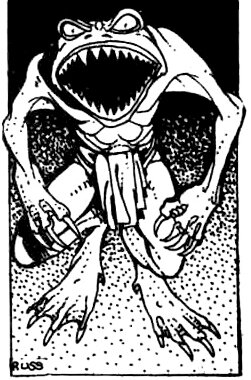
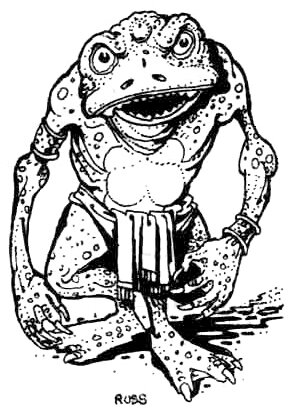
Showing posts with label review. Show all posts

Monday, October 14, 2024

Fiend Folio Review T-Z

Really this should have been finished a long while ago, but better late than never. Seeing the estimable Marsworms post her Part 15 (almost two months ago now -_-) reminded me I need to get this wrapped up.


Tabaxi
WHAT is that illustration, I want to shoot it with a hunting rifle. Much like with the Kenku, it is interesting to see the roots of what later becomes an extremely popular player character choice. This ancestral tabaxi is much wilder. I like the bit about them disguising scent with aromatic herbs. The tool use and innate weapon comprehension thing is weird. The cat behaviors could be played up more and them hunting in "prides" is silly. Learn about any cat other than lions people.


Tentamort
I must admit to a weakness for weird dungeon ecology creatures, especially one's with a name as excellent as 'tentamort'. The creature hits the sweet spot between too mundane and too weird. Defeating one would require some cunning and observation. My one qualm would be that it's liquid digestion needle attack is extremely lethal to a healing magic-less party, but that's an easy fix.

Terithran
The illustration is uninspiring unfortunately, and the entry's not great either, lacking a distinctive theme, aesthetic, or gimmick. I do enjoy the idea of an otherworldly creature just being pissed about wizard magic causing weird weather in their home plane and marching off to fuck the wizard up, but it is poorly implemented. The terithran is just some guy with miscellaneous spell powers who randomly appears to attack the magic-users of the party. There's nothing to really build it into a more interesting encounter.

Thoqqua
Larval rock-worm that melts its way through the earth and will set you on fire and melt your stuff if it attacks is pretty good, unfortunately there's no clear reason why it would attack besides "because." Once again we have an example of a monster who you can only interact with through combat. At least the khargra (which is of a similar type to this burrowing worm) had its affinity for metals and gems. Nonetheless I could imagine using the thoqqua as is, so it gets three stars instead of two. 


Thork
Giant metal bird which spews super heated steam. Hell yes. Another entry that hits the line perfectly between naturalistic and weird. It feels akin to the best of medieval and ancient bestiary entries. I can see myself using the thork as a piece of weird-wildlife for populating some jungle river basin, or island. As well, the description of its behavior if it is attacked (and the incentive to do so, owing to its valuable copper plumage) is well written in terms of utility in the moment; sucking up water in preparation for its attack and whatnot.

Throat Leech
Feels more like an environmental hazard than a proper monster, that said it's gross and nasty and creates a fun problem to solve.

Tiger Fly
Baffling illustration. Not really sure what the theme is supposed to be here. I do love parasitic wasps though and the egg laying is deliciously gruesome.

Tirapheg
Why's it got three legs, three arms (two nothing but spikes) three heads and a mouth in its belly? Why's it got two tentacles above its mouth? Who knows! It likes eating decaying flesh though and makes exclusionary copies of itself in a fight. Another entry which doesn't really have a readily comprehensible theme. Maybe it was pulled from some sci-fi novel? As an encounter its gimmicks are neat enough but there's nothing here that would let me plug it into a wider game world.

Trilloch
It's a life-draining energy blob which you can't interact with except for the spell 'dispel magic' and can't even detect without the spell 'detect magic.' Boo.


Giant Troll
It's just a big troll. Good illustration though, I like it's crude poleaxe.

Giant Two-Headed Troll
Again, it's just a big troll, but with two heads now. You already have a two headed giant, you literally mention the ettin in the description. At least make the heads argue. A missed opportunity all around. If you treat trolls as a sort of walking cancer you could have it be some horrible conglomerate of two trolls that regrew together and hate each other or something.


Ice Troll
Much better. Excellent illustration here, a nice enough variation on troll's normal regeneration gimmick although you lose a lot of the meat horror. Not stellar but I could see myself turning it into something fun.

Spirit Troll
It's a magic invisible fog troll which is a "perverted crossbreed of a troll and invisible stalker" yadda yadda. Does not bring anything interesting to the table.

Tween
Awful name. One of the worst kinds of monsters are the ones you can't hurt except with very specific spells/items. Kind of a neat idea, what with having a host and boosting their luck by seeing slightly into the future but at the cost of fucking over everyone else's luck around you, but seems like it would be frustrating in play and there's just no meat to it, evocatively speaking.


Umpleby
Hell yeah, weird seal guys. Actually, upon rereading this entry I can find no mention of the umpleby being aquatic. It just seems like they should be. Their hair nets are weird and go well with their electrocution attack (entangle then zap) and the dynamic of them forcibly joining a party as demanding henchmen is fun.

Urchin
Did the authors think regular sea urchins can shoot their spines like a crossbow bolt? Mildly baffling, would be like making an entry for dogs and then saying they have detachable tails that they can regrow. That said, I'm weirdly infatuated with these things (also the concept of sea urchins being able to infest land as well as sea is terrifying).

Vision
Doesn't even have a form. Vaguely attacks with illusions that you can throw off with a roll. Extremely boring.

Vodyanoi
Points off already for stealing the name of an excellent Slavic mythological creature and using it merely for a 'close aquatic relatives of the umber hulk'. Basically just a big underwater brute that rips up your boat and tries to eat you. I do like the hint at a salt-water species twice as large and more ferocious, that's nice. 

Volt
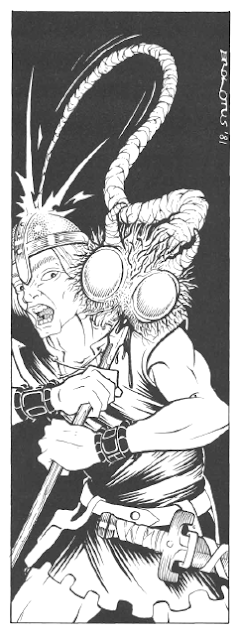
Funky little thing, feels like a Vancian monster. Has a nice lil gimmick (blood drain plus electric whip tail) and design. Could see these guys flying around in a wizard's lair after having broken out of their big glass holding jars. Maybe their from a strange moon.

Vortex
It's a whirlwind. Basically just an air elemental. Eh.

Whipweed
A murderous plantanimal. It's okay, not super exciting. Could put it in some murderous wizard garden or some such.

Witherstench
Evil skunk. Its stench isn't even as bad as a normal skunk, it wears off when the creature leaves. Good name though.

Witherweed
Really more of an environmental hazard than a monster, but a good one nonetheless. The toxic smoke is an excellent counter to a typical strategy and makes it a potential asset for players who can think up ways to exploit the weed's effects. Honestly I don't know why it has an attack, mechanically speaking, it would work just fine if grabbing at it poisoned you.

Xill
More parasitism baby. Good visual design, okay motivations, weird mechanical gimmick. Decently evocative. Could use some more elements to make encountering them interesting. 

Xvart
Boring humanoid made to fill a mechanical niche between goblins and kobolds that did not need filling.


Yellow Musk Creeper
Stellar. Stupendous. A weird fucking flower that makes zombies to propagate itself. It's weird, it's ecological, it's got a sick visual design going. It could be encountered in the wild or in a wizards fucked up garden. Could be weaponized by players. Maybe some prince is cultivating a garden of yellow musk creepers in order to unleash a terrible apocalypse.


Zombie, Yellow Musk
See above.

And that's a (belated) wrap!

Thursday, June 22, 2023

Morrow Project - Damocles, Review #2

Damocles, The Morrow Project.jpg

Onto module two! The first post of this series can be found here.

+++

THE PREMISE
 
This module takes place once again in Michigan, this time eschewing the warmer southern portion of the state for the pine forests and rugged hills of the Upper Peninsula. Again players take charge of a Recon Team, the most basic Morrow Project player unit, this time with a slightly different cold-weather adapted load-out.

As is typical, players awaken in their bolthole (slavishly described with technical detail as to its functioning, despite this being unlikely to factor into play of the module) with little information to guide them beside outdated maps. Presumably motivated by exploration, or seeking some of the project caches listed on the map, they will leave and wander out into the harsh winter of the new world.

The module bills itself as a sandbox, and as such loosely describes the region of the Upper Peninsula the players will find themselves within. Features of note are the harshness of the terrain, massive wolf packs, gangs of brigands descended from "cons" escaped from a penitentiary during the War, a nearby outpost of lake-going shipmen, a distant off-map university town with steam engine level technology, and of course the Damocles compound.

The compound and its titular inhabitant, a military AI named Damocles, take up about half the module's description after the broad strokes of the region and the loosely keyed town of Wittsend (plus inhabitants). It is, in all respects, the intended locus of play.

THE LAYOUT

Very basic, very homemade, 1980s chic. Two columns black and white. Minimum illustrations or maps. Some odd placement of sections, but for overall coherent and functional.
 
WHAT IT HAS

The supply caches are a good start to the sandbox, giving players immediate goals, and potential additional resources. Although, fascinatingly, the actual contents of the supply caches is left entirely up to the Referee. They are labelled on the player's outdated maps.

The module, in usually Morrow Project fashion, slavishly describes each and every component of the players kit, armament, and vehicles down to how many ounces of sunscreen the players have. While being a tad irksome to my usual tastes, this extreme detail isn't entirely without merit. The core premise of the game is that players are some of the last vestiges of the modern (at the time of writing) day now stranded in an alien world. What is in their kits is quite literally all they have of the old world (ignoring supply caches and such). As such it makes the play experience more visceral, particularly since the modules hold an unspoken but obvious expectation that players will leverage their detailed gear list in trade with the locals. And to this end the Recon Team’s detailed kit is actually quite useful.

The module opens up in the depths of winter, January to be precise, and this specific choice of season does well to lend the environment a distinct character of its own. The sketch of local terrain and clime makes sure to describe plenty of hazards and challenges for players to confront.

The real good stuff comes in the sketch of the region, which unlike the previous module Riverton with its isolated impoverished farmers, has far more ties to a wider world as well as a unique aesthetic to the region.

Notable details include a university city-state in Marquette to the northwest which is said to have steam engines and has attempted to introduce coinage to the region (with limited success). Details about schooling are given, including the note that local villages and woodsmen send their most promising youths on pilgrimage to the Northern Michigan University in Marquette to study (with notes on the particular subjects most valued and how the University has would-be scholars help maintain its fields, all very fun lil ways-of-life details). There is a widespread usage of flintlock rifles and muskets for hunting and a cottage industry maintaining them. A sketch of local governmental structures (or rather the lack of) is made with an emphasis on informal laws and appointed mediator-judges. Books are said to be valued, but rare, and apparently Shakespeare, Nietzsche and other classics are very popularly known and discussed. Delightfully it seems Ojibwa has made a comeback, intermingling with English and Finnish as the local dialect of choice.
 
One faction (though I hesitate to call them such, as they are not fleshed out enough to be a real faction, but they are certainly an implied faction) is the “cons” who are roving bandit bands formed from exiles and descendants of convicts who broke out of the state penitentiary. They are described as having "no society to speak of" and "initiation rituals" which, yeah, pretty typical 1980s attitudes towards imprisoned populations. Interestingly however, and in contradiction to the previous, it is briefly noted that the “cons” keep families in their camps and that books and horses are said to be the items most commonly traded for by these brigand bands, which has some delightfully implications. Another good detail is that there's a common belief in the brigand-gangs having a big conspiratorial alliance, which is said to be untrue. A good touch.
 
The social effects of prolonged raiding and low level warfare between the brigand gangs and settlements is also a good addition, as it further characterizes the settlement pattern of the region and its people. A lack of isolated farmsteads, walled towns, people going out to farm in groups and returning at dusk. These are all useful details for a Referee attempting to portray this post-apocalyptic society. And offer up some potential hooks.
 
There are also the Lakers, a group of nomadic ship-people who get a little mini-section. They’re wintering on a nearby island (connected by lake ice to the mainland), are suspicious and armed, but potentially hold large amounts of information concerning the broader world as well as connections to it for players.

The village of Wittsend (the only described settlement sadly) is presented well, in terms of what the players from the past will notice: lack of power lines and such (being stripped for metal), more barns. And has a complement of colorful npcs organized into lil factions with their own wants.

And lastly, there is the titular Damocles. An ancient military AI busy squatting in its old compound fulfilling ancient directives while sending out strange robotic scouts to plunder metal for repairs from the surrounding area. Damocles's compound forms an open ended mini-dungeon for players to deal with. It is heavily (and I mean heavily) armed and there are extensive notes about the history of the compound, its fancy tech, and features and some neat (if clumsy) storytelling via the various corpses of the long dead base personnel and the commander’s journal.
 
WHAT IT LACKS

Damocles bills itself as a sandbox, a space for Referee to build a campaign off of. And it almost, almost gets there. Yet I find it to have fallen short, lacking a robust framework of factions or points of interest or intersecting motivations or anything to really sustain long term play. It alludes to these things, yes, and sketches out a potential sandbox. But the actual work of filling it is left, in a very early roleplaying game fashion, to the Referee.

In truth there is just Wittsend, Damocles, and some threads leading off the edge of the map which is otherwise empty.

WHAT'S JUST WEIRD
 
I would probably need to be more familiar with the cultural milieu of the 80s in order to understand some of the stuff going on with the module's treatment of Amerindians and such. I've mostly glossed over that, and the bits with the Finns as well, but the way the Morrow Project approaches ethnicity will come up again in later modules and while not egregiously bad it's certainly... interesting. Depictions are very stereotypical even if intended as friendly.

CONCLUSIONS

The Morrow Project is different from most other post-apocalyptic media, particularly in the RPG-o-sphere, where most works tend to run either gonzo (Gamma World, Mad Max) or at least cinematic (Powered by the Apocalypse, Walking Dead). Morrow Project meanwhile engages with realism on an interesting level, being concerned with such details as farming and clothing and infrastructure. This often generates tension however, with the other half of the game, which is very much about heavily armed players blowing and shooting shit up. Nominally however, the game is about “rebuilding civilization” and as such is concerned with infrastructure, hygiene, farming, and other such features of the apocalypse.

It’s what has made me so fixated on the game and its modules and often what frustrates me with it, because I don’t want another several pages of statted up guns I want more ethnographic sketches about these post-apocalyptic societies!

Overall, despite its flaws, the Damocles module sparked my imagination. With a bit of work it can be expanded into an actual sandbox worth running and most of the ideas it does present are interesting and fun, there simply is a need for more of them in order to flesh out the environs. Having read it, I am enticed to find out how players would interact with the contents, and in that regard it is a success.

RANDOM THOUGHTS

I really like how the Lakers exist in this module, and particularly how they tie in with the local glassblower, it's an actual proper seed for sandbox intrigue and offers a way to draw players into the wider setting. And it does this through a criminally underused historical industry, that being the production and trade of glassware.

+++

The map for this module places it firmly in the region east of Marquette, just below grand island and just south of Munising, Mi (the rough location of which is marked as 'ruins' on the map). Continuing the Morrow Project tradition of loosely copying real world locations. The module even recommends purchasing a copy of USGS MAP NL 16-5 for Marquette, which is a charming little detail.

+++

It's nice to see Michigan’s wolf population has returned after the nuclear war. Personally I would have gone with some mixture of feral dogs interbred with coyotes and wolves.

+++

For some reason the module uses “upanite” which is an odd exonym, given that “yooper” is the commonly accepted term for the Upper Peninsula's inhabitants since the 70’s at least and sounds much better to the ear.

+++

Damocles is, for its flaws, much better tied into a region than Riverton which mostly just nebulously existed all on its lonesome. With Wittsend there is a sense of being placed in a broader world, and I’d love to expand the Upper Peninsula as a setting using this module as a base.

+++

It's strange to read about harsh, all consuming winters and omnipresent cold when the Upper Peninsula of my lifetime has gotten warmer and wetter even in deep winter due to climate change.This cold will actually come up in future modules, as it ties into a bit of a cross-module theme of an oncoming ice-age triggered by the nuclear war.

+++

While mostly a sandbox, the module has some odd bits of railroading, or rather not so much a railroad as an expected unfolding of events it presents to the Referee.

+++

The encounter with the local boy, in buckskins, busy cursing, shooting, reloading, and shooting his flintlock at the tank with robotic arms currently dissembling his snowmobile is a fantastic introduction to the new world for the players and makes me want to run the module for just that bit alone.

+++

I enjoy  the sense of growth and rebuilding in the module. People are hoping for things, have dreams, the townsfolk want a school, the glassblowers are hoping to make a trade deal that will get their glassware traded all across the lakes. It fits well with the player's presumed mission goals of helping rebuild civilization.

Friday, August 19, 2022

Tomb Robbers Of The Crystal Frontier - Review

Some might say that the unique setting proves detriment to a dungeons utility as a generic or learning dungeon. This might be the case, however Gus L's Crystal Frontiers setting walks the perfect line between vanilla and weird to make it work.


TOMB ROBBERS OF THE CRYSTAL FRONTIER

Aesthetics

Perhaps my favorite part, its a superb science-fantasy wild west with swaggering duel-happy lansquenets and scurrilous crystal prospector. Its Weird but with all the familiar tropes so that you grasp its essence in an instant And gosh does Gus's art support the vibe. Just look at the cover, its gorgeous. The book as it is slots, somewhat subtly, into the wider world of Gus's 'Fallen Empire' but can be easily used separately.

The fonts are a delight whilst still being readable and the book is stocked with plentiful illustrations that both codify its aesthetic and provide reference for npcs, monsters, locales, and features. 

Also I just adore the colors, their so fun!!

Layout & Tools

The information presentation is, to put it mildly, excellent. 

Room keys are formatted so they lead with a brief at-a-glance description featuring bolded lines for key details. These bolded lines refer to expounded upon sub-sections that describe the key features (being those bolded key details) more closely. It flows smoothly as you read, and makes for easy reference and skimming. Perhaps not as easy skimming as full bullet point keying ala Into the Odd's Iron Coral dungeon, however the denser text offers more detail that would otherwise be left out (or left to be inferred/invented) in the bullet point method.

When it comes to the mapping, all is done by Gus's own hand matching the rest of the books art. Clear and readable but not without style. In addition to the main isometric and top down maps (yes there's both) each 'section' of room keys has a relevant snippet of the main map, handily cutting down on page flipping. More dungeons should do this.

Furthermore, in the appendix a blank player map, and a referee map keyed with treasures and details right on the map are provided. Really this book has bountiful resources for rendering running a breeze. There's even a bevy of turn/torch tracker sheets, faction relation tracker sheets, and so on in the very well stocked appendices.

Content 

Tomb is an excellent learning dungeon, up their along Tomb of the Serpent Kings or Lair of the Lamb and other classics of recent years....

A couple of the traps were hard to parse even on rereading (the prism tomb particularly) however the book goes out of its way to diagram things and includes advice columns for nearly every notable feature explaining the decisions put into it. 
 
All of the dungeons features are highly interact-able and offer great potential for creative problem solving and shenaniganry on player's parts. Furthermore, the dungeon very nicely handles its danger such that players can always accidentally or intentionally trod right into the middle of things yet the more dangerous elements are also secreted further back in the dungeon so work must be put into reaching them.

Speaking of those elements, Tomb Robbers handles its stocking excellently with a mix of dumb monsters, problem solving monsters, faction monsters, boss monsters, and so forth and so on. Consistently providing advice for how to run each.

Truly the advice columns are one of the best part's of the module. They are succinct, clear, and are of immense assistance to new referees running the dungeon. RPG texts that take the time to explaining their reasoning and offer guidance are unfortunately not as common as I wish they were, which makes Tomb Robbers a delight.

In addition to the dungeon proper, the book includes a short section on Scarlet Town, packed with enough hooks and details to easily facilitate play there with no further prep of the Referee's own if they should so choose. Or easily providing a starting off point to expand and explore the Crystal Frontier. 
 
If I'm quite honest Scarlet Town was one of my favorite parts even in proportion to the rest of the dungeon. I'm a sucker for the rough and rowdy pseudo-western setting being sold here.   

And the appendices!! These go the extra leg and expand on magic items, spells, monsters, and setting elements. As well as end-case scenarios for different elements of the dungeon (what if so-and-so monster escapes, and so on). The aforementioned Scarlet Town of course, and the aforementioned referee tools. The crowning section of the whole book. 
 
Also there's a wandering arcanovoric owlbear and I love Gus's take on owlbears so much. Its just great.


THE BROKEN BASTION

The layout here is still quite excellent, though the very long vertical text blocks are tad hard to parse, they break up the long paragraphs in an odd way I find. It gets much better in the keying proper however where the sub-sections break it up.
 
The blocks of advice are killer, as much as they were in Tomb Robbers.

A very dense dungeon, both in information presentation and moving-dungeon-parts for space. Numerous interact-able components are provided for players to mess with, and numerous creatures and monsters to interfere with their exploration. Special movement procedure suggestions. Traps, treasures, and arcane technology.

I confess that I had a trickier time 'holding it all in my head' for this dungeon's content than I did with Tomb Robbers. I cannot place quite why, but I suspect the density of text and features as it related to the layout which was more cramped than with Tomb. However, it is a very flavorful, and well put together dungeon.
 
Like with Tomb, there is an appendix for treasure (of the magical sort) which is very handy. 


THE STAR SPIRE

An excellent lil dungeon, easily slotted into a game when in need of a small one session (or even half-session) dungeon. It would be fairly easy to reskin while keeping its essential character too
 
It does feel a tad sparse when it comes to interact-able elements in the dungeon proper, which makes the module feel more appropriate for players who've gone through a dungeon or two already and have acquired some tools or tricks that they bring with them (or perhaps for a game where they start with some 'problem solving potential' items). However, it is a short dungeon so you can't really hold that against it. 
 
The approaching rival treasure-hunters provide a nice threat and social encounter to be navigated and are, along with the automaton, the real meat of the module in terms of play (I suspect, having yet to run it, I certainly plan to however).

The lil isometric map is wonderful and utilitous. 
 
In terms of layout it has all of the same qualities previously mentioned, but more compact. Also in my copy the lettering seems a bit squished latterly? That could just be a result of my computer however.  


THE BRUJA, THE BEAST, AND THE BARROW

For a short four pages a lot is packed in here. 
 
Firstly, both the palette and dungeon itself are delightful variations from what has previously been provided in the form of a more traditional tomb complex, yet still tying into the rest of the region's wild west science fantasy airs. In particular subtle details are seeded pertaining to the titular bruja and beast that tie into another portion of the setting previously only mentioned in vague snippets. I enjoyed the greek hoplite theming for the tomb, an underutilized aesthetic.
 
The tomb as a whole presents an open ended situation of simple two-sided (or three if you count the players, perhaps four if you count the dungeon itself) factional relations. Marble-Eyes the sorcerer is a compelling npc and a good potential low-level ally to players (and potentially a fun low level antagonist as well). The beast boasts and lies and is formidable opponent but also one who players control if they interact with.

The dungeon itself is the perfect size for a session's worth of play, mostly linear with one branch, decent treasure (including some interesting magic items), and an two-three points of open-ended problem solving.


******
 
And there you have it. Tomb Robbers of the Crystal Frontier can be purchased here along with the rest of Gus's Crystal Frontier products (and much else besides). Gus's current blog can be found here, containing much sagely advice as well as play reports from running Tomb Robbers.
 
(sorry I took so long writing these reviews Gus :p )

Sunday, June 26, 2022

Morrow Project - Liberation At Riverton, A Review

Liberation at Riverton - Wikipedia

My first meeting with the Morrow Project came in the guise of Different Worlds Magazine, Issue 33 which I inherited along with two issues of Dragon, a copy of the AD&D 1e Players Handbook, Moldvay Basic Set, and a handful of modules. The meeting was brief. A short module featuring a plague carrying biker gang along with some Q&A of the authors. But it wormed the game into my brain and eventually I scrounged pdf's for it out of the corners of the internet and read through them. 

And I was charmed. Its an old, idiosyncratic game but interesting in its presentation of details and has some surprisingly well made modules. So as I reread the Morrow Project's books I will be reviewing them, in hopes that this might introduce other folks to the game. 

Now the obvious place to start would be the actual ruleset. But I shall do however I please, and instead we're starting with the very first module, "R001 Liberation At Riverton." 

The Premise 

Players are team members of the "Morrow Project" (a secret enterprise to assist in rebuilding civilization after nuclear war) cryogenically frozen to wait out the imminent apocalypse which indeed, comes and goes. They wake up 150 years later in a 'bolthole' with supplies, armaments, and amphibious assault vehicle. Their mission is vague "fulfill the project's goals: help people, and make contact with prime base and other teams."

The players awaken in the vicinity of 'Riverton' a town of unnamed location*, near a National Guard training camp which was nuked during the war, although the nuke fell south of target. The town was subsequently razed in the war's immediate aftermath during fighting with refugees and marauders. Present day the town has been reduced to numerous isolated farmsteads and a small "town" in the southeast of the old ruins proper. 

Ruling over the locals are the 'Imps' (derived from MP, the contraction of Military Police), remnants of the National Guard unit who had been stationed at the nearby camp. Over the years supplemented and supplanted by recruited vagabonds. They have a stockpile of military equipment, including small arms, mortars, jeeps, three trucks, and three tanks. The Imps spend their time roving about confiscating supplies and terrorizing the locals who are resigned to their fate. 

Into this enter the players.


* The town of Riverton and the national guard camp are in fact, blatant serial number filed off versions of Grayling, Michigan and the nearby Camp Grayling. The regional map itself is an almost 1 to 1 reproduction of the local area (just compare the two on google maps).

Layout & Art

The module is very much a product of its time, and quite home made to boot. Information comes variously in dense, hard to scan blocks or in easy to read, broken up sections. Of spelling errors there are numerous. Nonetheless there's a clear amount of effort put into it, and its certainly far from the worst layout I've seen! It does its job (not to mention the printing quality and subsequent scan quality of the pdf I'm using are partially to blame for bad readability). The section describing the Imp camp is well laid out in particular.

The art meanwhile is sparse and also of homemade quality, nothing to write home about but fun in that charming early RPG game way. The maps provided for both the camp and town are a tad hard to read, but do their job. The keying is adequate, but given the size of many of the maps, as well as the blank space, on the page it might've been more useful to just write out building and room names rather than muck about with numbering/lettering.

The regional map feels superfluous, and does not provide all that much usable information. No particular farms are shown, nor an outline of the local ruins. And given the discrete nature of the module's few points of interest, it's fairly easy to run it as a theater of the mind pointcrawl. That said, it is still useful to know the relative positions of the town to the camp, the local lakes, and the old roadways running throughout. And I cannot fault the module too much for this map, given that it is typical of many other rpgs of the time (not to mention that point crawls didn't exist as a concept yet :P). 

Farmers & Townies 

The locals get a big, rambling, multi-paragraph long write up. They are a simple, isolationist lot, largely defined by their fear of the Imps*. While the write up is long, hard to scan, and repetitive in places, it does provide a good sense of their character and provides actionable information for how they'll react to both players and player actions.

Of the locals, the townies (who live in the small, mapped out 'town' beside the overgrown ruins) get the most description and their meaningfully differentiated from the farmers in their attitudes towards the Imps. Not true factional difference, but difference none the less. A blacksmith and his son (who salvage metal from the ruins), an innkeeper and his family, a "store" (run by wandering horse traders whose stock was stolen by the Imps several years ago), a doctor (former wandering "emdee"), and two farming families. In addition there's a ruined farmstead, the family mysteriously poisoned after refuting the Imps. 

The secret of the farmstead is later revealed to be radiation poisoning from a "blue undead" one of the Morrow Projects few fantastical elements. A sort of radioactive zombie-ghoul, that the Imps keep in an old munitions bunker.

All together the module provides several npc's, hooks or at least interesting details for most, and provides an interesting problem for the players in that most of the locals are cowed by the Imps and too scared to take any action. Much of a play through might be sussing out the willingness of various townies and farmers to fight, or convincing the others. 


*An important note. There’s several (at least four cases I think) of implied and pretty-much-just-outright-stated sexual assault in the module. None directly “shown” but aftermath and history of it springing from the Imp’s abuses are prevalent. 

The Imps

These fellows get a large chunk of writeup. Most of which is dedicated to describing their compound and equipment.

Most of the Imps we learn are thugs recruited from wandering brigands and are a foul, brutish lot with simple discipline, of which, quote "there are no good ones." They're the nasty bad guys to beat up essentially. However they are neither a unthinking horde nor are they without internal divisions! A detailed breakdown is given of how the Imps structure themselves (in a corrupted form of US army structuring)* and a write up of their officers. 

The officers are divided up into four "nco's" (sargents essentially) and two "co's" (lieutenants all) all overseen by a simmering gout stricken "captain." Each is fairly well written up in terms of personality, and plenty of hints are given at how eager each is to go at each others throats. 

Of equipment both weapons and misc. gear is described well, with information as to how exactly the Imps use each. Giving a complete picture of their tactics. Though the information is bit spread out and could be condensed into a 'battle plan' section. All the equipment in working order feels a bit extensive, but 150 years is a short enough time that I can buy it since its been taken care of consistently and is described with signs of use, wear, and inhabitance. 

Of this I must also level my biggest criticism. That the Morrow Project suffers from an inordinate love for military gear, devoting altogether too much time to statting up the specifics of particular guns (though mercifully confined to the appendix for the most part) and vehicles leading the system and its adventures to flag in other areas. I find that the cultures of the post apocalyptic world aren't explored nearly as much as I would like. 

Next comes the camp map and keying. All of which is goodly done, with many little details that add to the previously mentioned tactics, or simply provide implications and inspiration. 


* While structure is described, exact numbers for each element (squad, platoon, etc) are not given. I would guess that the writers assumed the reader would be familiar with the terms.  

Closing 

The module finishes up with a rough outline of how play should go. While it does feature players auto-colliding with a recently pillaged farmstead, as a means to introduce them to the situation (and likely push them into aligning with the locals forthwith), it is largely open ended. More of a guideline for how the situation might play out unaltered upon player's introduction, than any kind of railroad. 

Taking it alltogather, I would say that....

The modules strengths lie in its sandbox design that presents an immediate situation for the players to involve themselves in (granted, a very black and white one, but an immediate conflict none the less). With both a small social web to navigate and a dangerous and powerful opponent of whom the means of defeating is left open ended.

The modules flaws lie in the lack of stronger factions (though that is a halfhearted criticism since most of the npcs can be easily fleshed out into more dynamic factions from their description) and various small details of layout, system, and style which make it clunky to work with, but are far from sinking it as an adventure.  

It works well either as a one shot hack and slash, shoot em up, or as an introduction into the post apocalyptic world for the players. However in the latter case some good hooks, implied or stated, to the broader world will have to be contrived by the referee. 

***

All together a solid little module, and a strong start to this review series. 

Random Thoughts 

Where are the Imps making or getting the alcohol to fuel their vehicles? 

An easy way to tie Riverton into a broader region would be to have the Imps trade with a nearby distillery or perhaps have oil fields (there are small oil fields near Grayling in real life) to fuel their vehicles. 

The real Grayling sits right on the I75 Highway that cuts up the whole of Michigan and down down into the southern states, while likely in no great repair, it could be a connecting route for traders and their ilk. Of course the Imps are likely holding trade up with taxes and tariffs. 

Friday, April 29, 2022

Books I've Done Gone And Read

Being, as is previously stated, a list of books I've done gone and read and my miscellaneous thoughts upon them. 

The Three Musketeers (Alexander Dumas)


I'd attempted to read this several times before and succeeded in finishing this time. There's a perverse tragic hilarity to the story, most of the characters are often fairly awful people but are nonetheless entertaining. The whole thing meanders about, speeding up in places and rushing along before cooling and wandering once more. This varied between enjoyable and annoying for me, depending on how I felt about the particular chapter.

Milady is perhaps the best character, she radiates palpable fury, the first time we actually get a close look at her and hear her speak in the text she dashes a fan to pieces in rage. I'm not sure if any of her portrayals in film really match up to how I now imagine her.

After Milady, the lackeys are my favorite (and their absence in many adaptations is a tragedy of its own). They are often abused. Often comic. Generally oozing with character. You could very easily drop both one of the musketeers and their lackey into the setting and have an instantly working and dynamic set of npcs. 

The bastion picnic scene is fantastic. 

Dumas has a love for melancholic endings if the Count of Monte Cristo is anything to go on for comparison. Or perhaps it is merely the modern eye that turns the endings so melancholic? I am unsure. 

The Dragonmasters (Jack Vance)


A shorter novella that verges on dull at places but wins the day overall with several excellent concepts, a clutch of interesting characters (personally I found Ervis and his retinue to be the most entertaining), and some segments of engaging prose. 

It engages with one of my favorite tropes of humans warped and domesticated into utilitous forms by aliens, and adds a further dimension in classic weird fucked up sci fi fashion by having had the humans do the same right back to the aliens. And then to add to that invents an entire miniature system of warfare utilizing those alien ‘dragons’. 

The ending tantalizingly suggests the thought of writing a sequel charting some descendant Banbeck in their newly formed interstellar empire or some such.

I feel that the story would make for an excellent short comic.

Hawks of Outremer (Robert E. Howard)


I found the prose to be lacking in the requisite detail to have it read as historical fiction, instead coming across as a glossed over ‘vaguely medieval’ fantasy style. Which in turn failed to alleviate the prevailing orientalism. A pity, because I was quite hooked by the opening wherein Cormac recounts his various adventures prior to the story. And I find the way Cormac himself plows through the plot like a murdersome, bloodstained 18-wheeler to be quite entertaining. There are hints of a better story within, one that explores the knavish nature of nearly everyone involved in the late crusades through the lens of an amoral but ragefully loyal mercenary. Not Howard’s best, but not the worst either. 

Invisible Cities (Italo Calvino)


Calvino is evocatively philosophical, and the text is wonderful to engage in on a surface level of simply pillaging ideas or on a deeper, contemplative plane. I quite honestly need to read through it again, to parse some of the deeper meanings behind the matter of cities and their metaphysical natures. It's not hard, given the short length. I’d really love to get my own copy. The dialogue between Kublai Khan and Marco Polo alone is worth the price.

The Stars Are Legion (Kameron Hurley)


DNF 25%

I feel bad about not finishing this book, it was actually beginning to get enjoyable but I fell off it due to outside factors and haven’t picked it up to finish yet. The vagueness and angst early on in the story were frustrating, but once it gets rolling along and more details are revealed it's not as bad. There are of course, decaying meat-moons which already puts it on a high grade.

However, the description could have strove for greater decadence, chewiness, rather than the workmanlike prose it had. Perhaps this was intentional to match the barebones material culture (very little metal, everything's meat). But still some nice juicy descriptions of viscera would be good.

Nomads of the Time Stream (Michel Moorcock)


DNF at 2 stories out of 3

I didn’t finish, not for any particular reason, I simply didn't feel sufficiently inspired to wrap it up though I enjoyed the first two stories I read.

I contend that the best bit was the initial introduction which while steeped in orientalism had wonderfully evocative description as well as solid enough motivation on part of the protagonist to keep the story flowing (later on he just drifts about, rather a non-character and more just a viewing scope).

Besides the opening, I found the Land Leviathan to be more compelling than Warlord of Air. Its display of bigotry and atrocity is more direct and upfront, and its super science flows more believably (amusing given that it features giant city sized fortress ziggurats) thanks to the widespread, global altering nature. However, its examination of race and imperialism is still clumsy. 

All together a neat little read, not particularly inspiring (except for that opening segment in Teku Benga which was really well put together) but interesting, and certainly displays Moorcock's prose. 

Elric of Melnibone (Michael Moorcock)


When it comes to "antiheroes", particularly the kind prone to philosophizing it is often a coin flip whether they are insufferable or enjoyable. Fortunately Elric is the latter. His brooding, while grandiose, never crosses the threshold of frustration and elicits genuine sympathy. Whilst be contrasted deliciously against the cruelties of his station and people. 

Moorcock's prose is clear whilst being decadent in detail. The plot is a solid pulp fantasy yarn the way through. The aesthetics and environs are refreshing coming out of the current fantasy milieu, delightfully weird and sometimes incoherent as well. 

I'm half way through Sailor On the Seas of Fate as I write this. 

The Carpet People (Terry Pratchett)


A re-read. And well worth it. 

As time passes my love for novellas and shorter stories increases. Not everything (especially in fantasy) needs to be sprawling multi-tome epics. The Carpet People manages to accomplish an entire drama, with big climatic battles and all in a short space (which I am just now realizing is rather delightfully appropriate to the setting of the novel). It's exactly as long as it needs to be. A practice more books should adhere to (though of course it does require some skill on part of the writer).

There is classic Pratchett wit throughout and the characters are simple but endearing, the same going for the environs of The Carpet, which would make an excellent game setting. Miniature worlds in general are underutilized, perhaps a post is in order.  

Friday, April 22, 2022

Unicorn Meat - Review

Dan D (of the venerable blag, Throne Of Salt) has recently released Unicorn Meat an adventure about a rundown unicorn farm in the backwoods taken over by ex-indentured, feral young girls, and other horrible thing. And it is fantastic.  

***

The safety section <3

***

There is a very deep sense of….. coziness? Is not the right word, humanity perhaps. Familiarity? Closeness? Despite the horrid situation. The characters in the module carry a large part of this. So does the setting, something about the muggy backwoods crawling with terrible monsters rings a note within. It all feels horrible in a deeply human and sympathetic way as well as alien and terrible.

The vaguely late 19th century setting also interplays quite well with the aforementioned familiarity (I do not think the module would work as well reskinned for a more medieval time period, its really well-knit (you could make it work definitely, just not as well))

***

Im not really sure why the muggy backwoods with Appalachian folklore mixed with root magic borrowings speaks so deeply to my soul and feels so... familiar, given how removed my childhood is from such contexts. But damn does it have Vibes. 

***

Layout is clean, simple, and flows like butter. The pdf is nicely hyperlinked. Text is broken up and spaced out, you're never focusing on more than a paragraph's worth of text at a time. Terms and names are bolded. Makes for easy skimming.

Visually, the illustrations really tie up the whole module in a bow. The npc portraits ooze personality (and make for handy little play aids). Theres just enough illustrations in total to nail down the vibes in your head without prescribing or limiting your own portrayal of the farm. 

There's some moments of more flavorful layout (like some <Redacted> black bars) however they don’t interfere with readability or usability at all, which is excellent. 

***

The tables for character creation are excellent and just beg to be used in rolling up a party of carvergirls 

***

Hits this blend of folkloric and not-exactly science, but more ‘sciency’, horror. Mutations and witchballs. Old folk magic pulled up from Appalachia and the swamps blended with ‘this is not a place of honor’ monoliths of a long dead culture. 

***

Oddly strong tonal similarities to Deep Carbon Observatory, would pair excellently with each other.

***

There's also still a lot of mystery and open-endedness to the module, not everything is fully explained. Like what exactly the beast-below is, or why there's a bunch of seemingly metallic but actually crammed with meat technologies. It's artfully done, enough to keep nagging at the mind, and keep it mysterious, but never a roadblock to play.

There's a segment on legends, nothing immediately relevant to play but which drives home the mood, and fleshes the carvergirl’s culture out for anyone running them.  

***

Unicorn poop can be smoked to make you high (also all the other skinning unicorns for parts).

***

Minor point, the beginning of the caves section describes travel as taking 1d4 hours between locations and this makes sense for a portion of it (the tangled caves under the swamp) but not other parts like the pit.

***

Instantly infatuated with all the npcs. There's a lot of humanity, both sympathetic and cruel, crammed into them. I'm reminded of the better kinds of post-apocalyptic media, where everyones broken in some way, even the awful one’s, and the humanity of it strikes a cord. Everyone’s fucked up, but its clear that its this polluted place and the evils done there that's done it

Near the start of the module there's a list of “things to remember”, in that these two are the first ‘you know these people, everyone has a name” and “everyone has friends, everyone has enemies”. Which drives home some of the modules underlying tone. Things are fucked up but everyones people.

(This also makes the monsters stand out even more, their proper weird and messed up).

Oh and also very simple, and yet excellently done factionalism.

***

Art by Rowan A.

Pugs and Birdie are my favorites I think, all the characters are amazing but these two are my favorites. Something about their demeanors makes my heart go out to them. 

***

Everything about the nightwatch, their tree, and the witching hour. Proper folk-magic (and horror) vibes that meshes fantastically with everything else. I feel like there could be a bit more allusion to the witching hours existence in other parts of the module, but gosh is it good.

***

The descriptions through the module are extra evocative, and minimalist in just the right way. Tiles described as teeth is one of my favorite bits. 

***

Random generation of a hunting expedition via drawing from a deck of cards is mwah, very simple, easy to use, and a fun and different way of doing random gen. Kinda makes the generation feel more oracular and less mechanical as it might if you were just rolling on tables. 

***

A little thing, but a solid chunk of the npc portraits are smiling, it's not necessarily a happy (or well… normal happy) smile, but a goodly lot of them are smiling in some way, something which says a lot about the tone I think.

***

I'm not sure how I would run this module with adult player characters. It can definitely be done, feels a bit tricksy to navigate, gotta hit the right tone for interact with feral children trying to knife you. Carvergirl games definitely would run more naturally. Im eager to her the play reports eventually roll in. 

***

“At least it’s not a hippo”

***

White-Eyes plan is just really good, the kind of thing where players end up torn on weither to stop it, join it, or what. Deeply sympathetic and also clearly about to unleash some chaos. Also just excellent as conceptual weird-ass magic-science (I adore the description comparing the Theocarnequs to the Beast as a god to a leper).

***

All the other stuff I didn't remember to include or couldn't properly express while writing this.

***

This hasn't really been a very coherent post, ramblings mostly, cause its just a damn fantastic adventure. I'm defiantly going to spring for a physical copy eventually. 

The time is neigh! You too should go out and get Unicorn Meat. 

Tuesday, August 24, 2021

Fiend Folio Review R-S

Here we go again! 


Retriever
A funky fellow, the different eye rays feel cobbled together, I would likely narrow the range of what they do if I reinterpreted, the spider aesthetic is good, cleaver arms used while the ray's are recharging good, all together I warmed up to this one a lot more on second reading. I adore this line, 'demons sometimes mount howdahs on the back of a retriever and ride the creature to the hunt' it pushed me over from being eh, to being yah! The name is odd tho, since it seems to come out from the singular line about being servants of demogorgon.

The Gallery: Art of Russ Nicholson: It needs to be said.. Some Fiend Folio  then

Revenant 
An undead with a purpose! Besides aimlessly shambling around. Silliness aside its nice to see an undead that comes back for matters of unfinished business, a classic staple of undead in folklore. The particularities about it being driven by sheer will power, and not necessarily being evil (and thus immune to turn undead) are wonderful and suggests that players can perhaps reason with it. Strangulation as method of choice, but being guileful enough to use other tactics. Retainment of some abilities from life. Just a solid entry all around.

Rothé
These are really just underground yaks but I like them regardless. Feels like something some medieval travelogueist would write about"'... and in the mountain caves there dwell short, yak like creatures that the locals do call rothé, which are shy beasts with an aversion to the rays of the sun...."

Sandman
I feel like you shouldn't be allowed to write a creature whose whole gist is putting you to sleep and then not have any weird dream adventures or mind eating happen. The Sandman could be great, but sadly falls extremely short here. I would steal its aesthetic and put it to better use.

Scarecrow
Bit of an odd one, but a decent monster. I enjoy that its 'charm' effect is one of fascination. Needs a bit more idea fuel and intractable elements for players.

Old School FRP — A screaming devilkin resembles a flying baby whose...

Screaming Devilkin
Is described as looking like a mephit. Art does not look like mephitic art (for the better I think, why have a entry that just looks exactly like another one). The pain howling screaming is rather neat in that it complete drowns out all player voices entirely. Yet another 'always attacks' monster though, disappointing if not crippling since it should provide for a fun one off combat encounter. 

Shadow Demon
It's just a demon themed evil shadow. Normal shadow weaknesses and strengths. Eh I'm just meh on it. Maybe someone else has a more favorable look at it.

Sheet Ghoul
.... how does corrosive nose acid tie into an evil bedsheet....
Well its a decent enough sub-monster to go with the sheet ghoul.

💯 {Staff Pick} - [Let&#39;s Read] AD&amp;D 1e Fiend Folio | Page 269 | RPGnet  Forums

Sheet Phantom
Something tells me this and the scarecrow came from someones halloween one-shot. Its got a good combat gimmick going for it, attacks hurting its victims its draped over is a nice touch. The details about it perhaps being an undead form of cloaked are fascinating though bizarre and not to my tastes at all. Surprisingly I find myself giving this one a four out of five.

Shocker
Zap! Nice aesthetic, good abilities, lacking in behavior. I think it should have something more interesting to either do, or drop when dead. Give it an agenda, or a more unique treasure than gems. The 'others postulate the existence of an electromagnetic plane' line is good fun. Reminds me of the dune stalker, similar pulp sci-fi energy (in no small part due to the same artists illustrations).

A skeleton warrior resembles a lich, but is the undead form of a powerful  fighter dressed in remnants of fi… | Skeleton warrior, Old school, Black  and white artwork

Skeleton Warrior
Love this sucker, quality design right here. Could use streamlining like most of the entries (all this dross of ranges and what) I love the risk of losing the circlet and having the skeleton warrior straight up attack, as well if the warrior is being used by an opponent it creates further fun (I would be tempted to let the skeleton warrior communicate some way (perhaps writing?) to make for fun ethical dilemmas in controlling it). Their creation is a nice vague hook that could be nicely tied into a setting in some way or another. All in all one of my favorite entries.

Skulk
Fascinatingly weird entry, cuttlefish human sub species that hide from most society which will kill them if found out. Surprised no one has adopted this one for their edgy loner persecution characters (update: I have been informed they were a player race in 3e (?). This entry feels like it was written by anti-skulk bigots, 'their cowards who murder whole families in their beds!'. Fear-mongering the lot of it.

Slaad
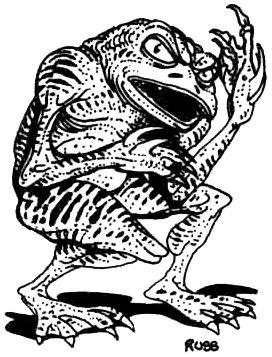
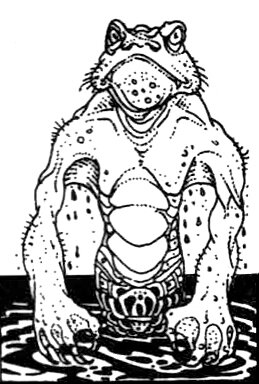
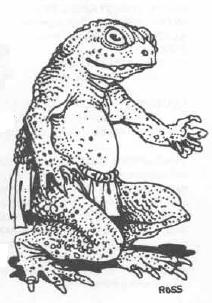
Chaos frogs chaos frogs chaos frogs. I'm wobbly on the slaadi symbols/head jewels, on one hand it makes for a neat method of control/summoning beyond true names. On the other they shouldn't require specific spells to remove. Unfortunately, though I adore them, the actual slaad entries are a bit lacking in distinction and unique gimmicks being rather same-y. 

(also it bothers me that the entries are not in their hierarchal order but rather alphabetical).
(also also all the dross about different percentage chances of gating in other slaad types is neat but a bit clunky)

Deep Dive - The Slaadi — Dump Stat Adventures

Blue Slaad
The blue/red rivalry is nice. The blue slaad only having defensive psionic has interesting implications for the other slaad (though not really expounded upon). Besides that there's three meh spell-abilities (which I must say I greatly dislike, an entity should have any abilities shortened to spells be tied into their character, not just pegged on with no discernible ties to their theme/gimmick).

Deep Dive - The Slaadi — Dump Stat Adventures

Death Slaad (the lesser masters)
Four is quite a small number! I feel like they should have a more coherent aesthetic (perhaps with individual differentiation (like the nazgûl)) if their so powerful yet small a group. I'd enjoy grabbing onto the detail about swords and expanding upon it since most of the other slaad don't seem to use weapons (except in human form?) and the mental picture of a hulking frog with naught but a loincloth and massive sword (heheh) is a good one. More spell-ability lists... sigh.

Slaad - Wikipedia

Green Slaad
Sadly lacking in unique gimmick or abilities, instead having a pile of a spell list. The illustration makes me think some kind of bureaucrat/consular/merchant-ly sort. The bit about reincarnating as a blue slaad if killed I think should be expanded to all the Slaad reincarnating as a color lower when killed.

Deep Dive - The Slaadi — Dump Stat Adventures

Grey Slaad (the executioners)
Unfortunately not as evocative as the name, pretty eh all around, not much I can even spin off of. Its all essentially just 'they will have spells and maybe some magic items'.

Deep Dive - The Slaadi — Dump Stat Adventures

Red Slaad
Decently set up, has more aesthetic coherency than the bloated spell lists of the others. The pellet bit is weird though evocative, feels like it should either just be venom/poison or you should be able to try and dig out the pellet with a knife or whatnot. Details on a Wish spell allowing for forcing it into obediance but only with other spells is weird but I guess it made sense in the milieu of ad&d's rules.


Ssendam - Lord of the Insane (slaad lord)
Giant amoeba with a brain inside. Beautiful. The black sword is interesting (potentially could tie into the death slaadi swords if you went that route). Sadly another spell list. Interesting idea that he always gives his name, very arrogant announcement like I presume. I think this entry has a lack of solid coherency/vibes/personality but the giant amoeba form is neat enough so I'll bump it up to a three star.


Ygorl - Lord of Entropy (slaad lord)
Hrm, aesthetics feel out of wack with rest of slaad and ssendam. Always being in shadow is neat. Sickle is a neat enough signature weapon (though feeling out of place with the rest of the slaad again). Sigh... spell lists.... the dragon steed is cute.

Snyad (pestie)
Pretty neato, solid behavior, most of the aesthetic draw is owed to Russ Nicholson's art, suggested interaction with mites is fun, feels like you could fit it into a dungeon 'ecology' easily. Small thieving humanoids are rather generic (this could easily just be goblins if this is how you wanted to do goblins) but it sails by with just enough of its own uniqueness. 

Pin on Fiend Folios &amp; Monster Manuals

Son of Kyuss
Excellent, could use some polish, cutting back of the ad&d dross and percentiles with disease infliction and what (its mostly just the intersection of the monster and ad&d rules which necessitates quantifying elements of the monster, so to be expected), but the base is sturdy as cement. Walking corpses full of worms that jump out at you to turn you into one of them. Probs one of the best undead, pity it doesn't see more use (that I know of). Specially since there's an excellent implied hook with the name.

Stunjelly
Ehhh, it's not bad? Its kind of just another tricksy ooze variant but it is sort of unique, disguising itself as a wall and paralyzing then trying to envelope. But its just a variation upon the basic gist of a translucent gelatinous cube  (which is mentioned in the very entries text). I might be being too harsh on it.

Sussurus
Fascinating entry here, another one with pulp sci-fi vibes. The dronesong effect on undead is neat, unexpected, and potentially very very gamible for players. Attacking oxygen consuming flame is also a nice touch that forces players to figure out how to interact with this beastie. I would love to throw this in as a random encounter in a bit of a gonzo game. It'd feel at home in the ultraviolet grasslands. 


Svirfneblin (deep gnome)
I found myself liking these fellows surprisingly, the excellent illustration helps, as well as several interesting tidbit such as their stun-gas darts (an excellent mental image there, of short underground folks flinging darts which explode in puffs of colored smoke). I like also, the mention of having to pay hefty bribes to escape earth elementals. But besides bits I can string out into more interesting features, most of the entry is decent at best. Lots of percentiles for things, some okay behaviors, more spell abilities, etc.

Symbiotic Jelly
A very d&d monster, existing within the context of treasure hoards and monster killing to acquire them. I personally don't like it, but it's a fairly solid monster as written. With a clear motivation, and some decently interesting tactics to achieve thereof with its charming of monsters and illusions of treasure and weakness.

My analysis so far has been rather slapdash, but if there's one thing Im hitting on it's the importance of a Gimmick for any entity. That being of course a combination of aesthetics, behavior, and abilities all tied up in a core idea of the creature which can be spun out and extrapolated upon. 

The Skeleton Warrior is a good entry because it has a solid gimmick with its control circlet, skeletal demeanor, and desire for freedom. The Green Slaad is a poor entry because it doesn't have solid gimmick, just a generic list of spell abilities. And so on and so forth.

We're getting near the homestretch!